
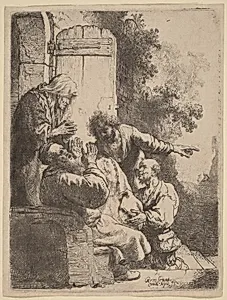
Joseph's Coat Brought to Jacob
c. 1633
Medium
etching and touches of drypoint
Classification
Department
CG-E
Museum
National Gallery of Art, Washington, D.C.
Credit
Rosenwald Collection
Accession Number
1943.3.7260
Rights
Public Domain
Art Historical Context
In the hallowed narrative of Genesis 37, Rembrandt van Rijn captures a moment of profound paternal grief in *Joseph's Coat Brought to Jacob* (c. 1633). This etching depicts Jacob, the aging patriarch, overcome with sorrow as his sons present the bloodstained coat of his favored son Joseph, falsely signaling his death. Rembrandt, at the height of his early career in Amsterdam, masterfully conveys the emotional weight of biblical betrayal and mourning, drawing viewers into the intimate drama of family tragedy. A pinnacle of Rembrandt's printmaking genius, the work employs etching with subtle touches of drypoint—a technique he pioneered to achieve velvety textures and dramatic light effects unattainable in earlier prints. The intricate lines build deep shadows and luminous highlights, evoking the chiaroscuro of his paintings while making the print a collector's treasure. Housed in the National Gallery of Art's Rosenwald Collection (Department CG-E), this piece exemplifies Rembrandt's Baroque innovation, blending technical virtuosity with psychological depth. Rembrandt produced relatively few etchings, yet they rivaled his oils in fame, circulated widely across Europe. This modest-sized print (classified as a print) invites contemplation of human vulnerability, reminding us why Rembrandt endures as one of history's greatest storytellers in art.
About the Artist
Rembrandt van Rijn · 1606–1669
Rembrandt Harmenszoon van Rijn (1606–1669) stands as one of the greatest visual artists in the history of Western art and the most important Dutch painter of the 17th century. Born in Leiden to a prosperous miller's family, Rembrandt transformed painting through his revolutionary use of light and shadow, his psychological depth in portraiture, and his elevation of etching to a fine art. His approx...