
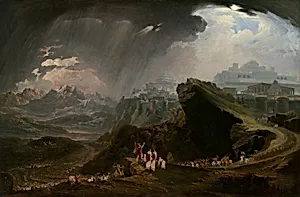
Joshua Commanding the Sun to Stand Still upon Gibeon
1816
Medium
oil on canvas
Dimensions
overall: 150 x 231 cm (59 1/16 x 90 15/16 in.)
Classification
Painting
Department
CAB
Museum
National Gallery of Art, Washington, D.C.
Credit
Paul Mellon Fund
Accession Number
2004.64.1
Rights
Public Domain
Art Historical Context
In the grand tradition of Romantic biblical painting, John Martin's *Joshua Commanding the Sun to Stand Still upon Gibeon* (1816) a pivotal moment from Book of Joshua (10:12-13). Here, the Israelite leader commands the sun and moon to in the sky during a fierce battle against the Amorites at Gibeon, allowing victory against overwhelming odds. This oil-on-canvas masterpiece, measuring an imposing 150 x 231 cm, exemplifies Martin's flair for the sublime—vast, tumultuous landscapes dwarfing human figures, bathed in dramatic light and shadow. Martin, a pioneering British artist of the Romantic era, was renowned for his theatrical, apocalyptic visions that blended historical accuracy with imaginative spectacle. Exhibited at the Royal Academy in 1816, this early work propelled his career, influencing later Victorian tastes for epic narratives. The large-scale format invites viewers into a cosmic drama, where divine intervention unfolds amid swirling clouds, radiant beams piercing the heavens, and tiny warriors below, emphasizing humanity's awe-inspiring fragility before God's power. Housed in the National Gallery of Art through the Paul Mellon Fund, the painting highlights oil's versatility for luminous effects and rich detail, making Martin's celestial pyrotechnics vividly tangible. A testament to 19th-century fascination with the Bible as spectacle, it reminds us how art can make ancient miracles feel urgently alive.
About the Artist
John Martin · 1789–1854
John Martin (1789–1854) was a British painter and mezzotint engraver whose apocalyptic biblical and historical paintings made him one of the most popular artists in early nineteenth-century Britain. Born in Haydon Bridge, Northumberland, he trained as a heraldic and coach painter before moving to London, where his monumental painting "Belshazzar's Feast" (1820) caused a sensation and established h...