
Jozef en de vrouw van Potifar
Medium
engraving
Dimensions
229; 165
Rights
Public Domain
About this artwork
collector's mark: Lugt 2228
Art Historical Context
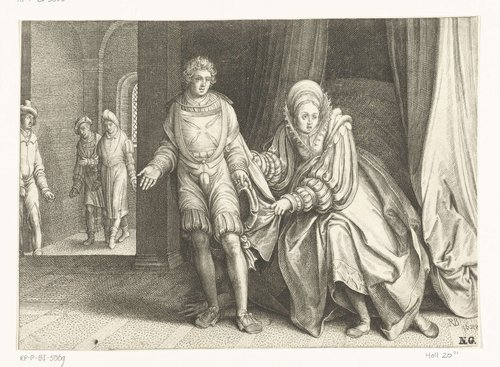
### Jozef en de vrouw van Potifar This captivating engraving, *Jozef en de van Potifar* (Joseph and Potip's Wife), was created by Dutch artist Nicolaes de Bruyn in 1628. De Bruyn, a prominent engraver from Antwerp active during the early Dutch Golden Age, specialized in intricate reproductive prints often drawing from biblical narratives and designs by contemporaries like Frans Floris. The work depicts the dramatic biblical story from Genesis 39, where the virtuous Joseph flees the seductive advances of Potiphar's wife, embodying themes of temptation, morality, and fidelity that resonated deeply in 17th-century Europe. Measuring a modest 165 × 229 mm, this engraving exemplifies the technical mastery of intaglio printmaking. De Bruyn's fine lines, achieved through meticulous burin work on a metal plate, create rich contrasts, textures, and depth via hatching and cross-hatching techniques. Engravings like this were revolutionary for their time, allowing widespread dissemination of complex imagery to a broad audience beyond the elite, making moral tales accessible in homes and workshops. Bearing the collector's mark Lugt 2228 (associated with 19th-century French collector Eugène Dutuit), this piece highlights its enduring value among connoisseurs. It invites visitors to ponder how such small-scale prints bridged art and devotion, preserving vivid storytelling in an era of religious fervor and artistic innovation.
About the Artist
Nicolaes de Bruyn · 1571–1656
Nicolaes de Bruyn was a Flemish printmaker born in Antwerp in 1571, active during the late sixteenth and early seventeenth centuries and known primarily for his large, elaborately detailed engravings of landscapes, hunting scenes, and biblical and mythological subjects. He trained in the tradition of Flemish reproductive engraving and was deeply influenced by the work of his contemporaries and pre...