
Judgment of Paris
mid 17th century
Medium
lead
Dimensions
overall: 6.4 x 6.2 cm (2 1/2 x 2 7/16 in.) gross weight: 47 gr
Classification
Sculpture
Department
CSD
Museum
National Gallery of Art, Washington, D.C.
Credit
Samuel H. Kress Collection
Accession Number
1957.14.589
Rights
Public Domain
Art Historical Context
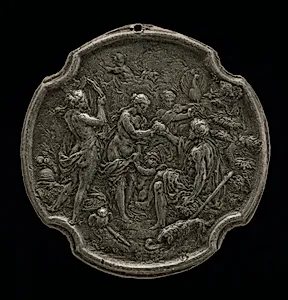
This small lead sculpture, created in the mid-17th century by an artist probably active in Flanders, depicts the ancient Greek myth of the Judgment of Paris. In the story, the Trojan prince Paris is asked to award a golden apple to the fairest among the goddesses Hera, Athena, and Aphrodite. The compact relief, measuring just over two inches across, captures this dramatic moment in fine detail despite its modest size. Lead was a favored material for Flemish sculptors of the Baroque period, allowing for crisp modeling and relatively quick production of intimate works intended for private collectors. Such pieces often served as portable reminders of classical learning and refined taste. The anonymous artist’s handling of the figures reflects the dynamic poses and rich narrative interest typical of Northern European art influenced by the grand mythological compositions of Peter Paul Rubens and his circle. Acquired as part of the Samuel H. Kress Collection, this delicate sculpture now resides in the National Gallery of Art, where it offers visitors a glimpse into the private artistic world of 17th-century Europe.