
Medium
Etching
Dimensions
sheet: 6 1/16 x 3 9/16 in. (15.4 x 9 cm)
Classification
Prints
Department
Drawings and Prints
Museum
Metropolitan Museum of Art, New York, NY
Credit
Harris Brisbane Dick Fund, 1926
Accession Number
26.70.3(86)
Rights
Public Domain
Tags
Art Historical Context
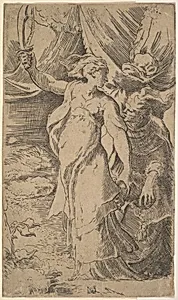
This exquisite etching, titled *Judith* and dating to the 16th, hails from the Italian Renaissance tradition. Attributed variably to an anonymous Italian or the Mannerist master ParmigianinoGirolamo Francesco Mariaola, 1503–1540), it captures the biblical heroine Judith in a dramatic moment, sword in hand—likely triumphant over the severed head of the Assyrian general Holofer. Measuring just 6 1/16 x 3 9/16 inches, its intimate scale made it ideal for collectors and study, now housed in the Metropolitan Museum of Art's Drawings and Prints department, acquired via the Harris Brisbane Dick Fund in 1926. Etching, a revolutionary printmaking technique pioneered in the 16th century, allowed artists like those in Parmigianino's circle to achieve delicate, fluid lines through acid-bitten metal plates. This method democratized access to sophisticated imagery, spreading Mannerist elegance—characterized by elongated forms and refined grace—beyond paintings to affordable prints. The work exemplifies how such prints served as reproductive tools, disseminating iconic subjects across Europe. Drawn from the Book of Judith in the Apocrypha, the story celebrates female heroism and divine justice, resonating in Renaissance art as a symbol of virtue prevailing against tyranny. This poignant depiction invites visitors to ponder its cultural weight, blending piety, drama, and technical virtuosity in a single, sword-sharp moment.