
Judith
Medium
Engraving on ivory laid paper
Dimensions
Sheet trimmed within platemark: 21.4 × 31.8 cm (8 7/16 × 12 9/16 in.)
Classification
engraving
Department
Prints and Drawings
Museum
Art Institute of Chicago
Accession Number
3711
Rights
Public Domain
About this artwork
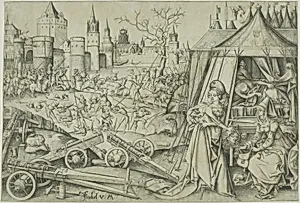
The biblical heroine Judith freed the Hebrews from Assyrian oppression by seducing the general Holofernes and decapitating him in his drunken stupor. Here Israhel van Meckenem depicted Judith stuffing Holofernes’s head into her maidservant’s pouch while a battle rages in the background. Van Meckenem’s depiction of the gruesome act is matter-of-fact. While the decapitated body remains visible, the sword is clean and the setting devoid of blood.
Art Historical Context
Israhel van Meckenem the Younger’s engraving *Judith*, created around 1495, captures a pivotal moment from the biblical story of the heroine who saves her people by slaying the Assyrian general Holofernes. Working in the Rhineland during the late fifteenth century, van Meckenem was among the most prolific engravers of his era, producing hundreds of prints that helped spread religious and secular imagery across Northern Europe just as the printing press was transforming visual culture. Executed on ivory-toned laid paper, the work exemplifies the early mastery of engraving as a medium. Fine, controlled lines allow for delicate modeling of drapery and expressive faces while making the image reproducible—an innovation that let devotional subjects reach audiences far beyond church walls or aristocratic collections. Van Meckenem often drew on the compositions of Martin Schongauer and other contemporaries, adapting them into his own crisp, linear style. Today the print resides in the Art Institute of Chicago’s Department of Prints and Drawings, where it offers visitors a vivid glimpse into the devotional and artistic concerns of the pre-Reformation period. Its modest size and intimate detail invite close looking, revealing both the technical precision of early printmaking and the enduring power of Judith as a symbol of courage and faith.
About the Artist
Israhel van Meckenem, the younger
Israhel van Meckenem the Younger (c. 1440–1503) was a German goldsmith and engraver who became one of the most prolific printmakers of the fifteenth century. Born in Meckenheim near Bonn, he was trained by his father, Israhel van Meckenem the Elder, who was himself a goldsmith and engraver. The younger Israhel may also have worked in the workshop of the Master E.S., whose plates he later reworked ...