
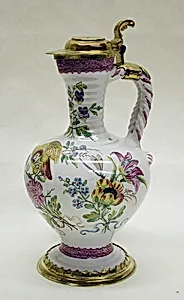
Jug
Medium
Tin-glazed earthenware, silver-gilt
Dimensions
H. 10-3/4 in. (27.3 cm)
Classification
Ceramics-Pottery
Culture
German, Augsburg
Department
European Sculpture and Decorative Arts
Museum
Metropolitan Museum of Art, New York, NY
Credit
The Lesley and Emma Sheafer Collection, Bequest of Emma A. Sheafer, 1973
Accession Number
1974.356.247
Rights
Public Domain
Tags
Art Historical Context
This elegant jug, crafted by Bartholom Seuter in Augsburg, Germany, around 1720, exemplifies the city's renowned tradition of fine decorative arts during the late Baroque period. Made of tin-glazed earthenware technique where a tin oxide coating creates a brilliant white surface ideal for vibrant painted designs—the jug stands at 10-3/4 inches tall. Its luxurious silver-gilt mounts elevate it from utilitarian pottery to a status symbol, blending ceramic innovation with Augsburg's mastery in goldsmithing and silversmith. Adorned with delicate motifs of dragonflies and flowers, the jug showcases Seuter's skill in polychrome decoration, a hallmark of German faience production. These naturalistic elements reflect the era's fascination with nature and ornamentation, bridging Baroque exuberance and emerging Rococo lightness. Augsburg workshops like Seuter's were pivotal in exporting such pieces across Europe, making tin-glazed wares alternatives to costly porcelain. Now in the Metropolitan Museum of Art's European Sculpture and Decorative Arts Department, thanks to the Lesley and Emma Sheafer Collection (1973), this jug offers a glimpse into 18th-century domestic luxury and craftsmanship. Visitors can appreciate how it transformed everyday vessels into artistic treasures.