
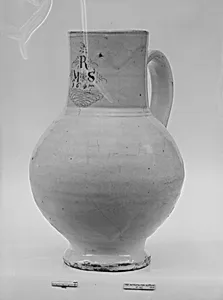
Jug
ca. 1647
Medium
Tin-enameled earthenware
Dimensions
H. 10 1/8 in. (25.7 cm)
Classification
Jug
Culture
British
Department
The American Wing
Museum
Metropolitan Museum of Art, New York, NY
Credit
Gift of Mrs. Paul Moore, 1937
Accession Number
37.107.2
Rights
Public Domain
Art Historical Context
This charming jug, crafted by the Lambethories around 1647, exemplifies early English tin-enameled earthenware, a technique borrowed from Dutch delftware masters. Standing at just over 10 inches tall, its tin glaze provided a smooth, white surface ideal for vibrant painted decorations, mimicking expensive Chinese porcelain at a fraction of the cost. Produced London's Lambeth district, these factories were pioneers in Britain's burgeoning ceramics industry during the mid-17th century, a time when pottery shifted from utilitarian to decorative household wares. The jug's historical significance lies in its role as a practical yet artistic vessel for serving beverages like beer or wine, reflecting the everyday life of British households amid the English Civil War era. Tin-enameling allowed artisans to apply bold colors and motifs—often floral, biblical, or nautical—fired at low temperatures to preserve their vividness. As one of the earliest examples from Lambeth, it highlights the rapid adoption of this continental style in England, bridging European influences with local craftsmanship. Housed in The Metropolitan Museum of Art's American Wing and gifted in 1937, this piece connects British ceramic traditions to transatlantic histories, underscoring the global exchange of techniques that shaped colonial material culture. A delightful glimpse into 17th-century domestic artistry!