
Jug
Unknown Artist
ca. 1835
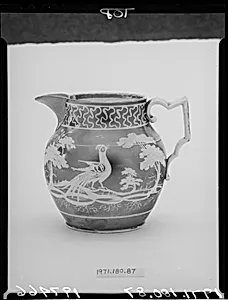
Medium
Earthenware, lusterware
Dimensions
5 1/16 x 7 1/8 in. (12.9 x 18.1 cm)
Classification
Jug
Culture
British
Department
The American Wing
Museum
Metropolitan Museum of Art, New York, NY
Credit
Bequest of Flora E. Whiting, 1971
Accession Number
1971.180.87
Rights
Public Domain
Tags
Art Historical Context
This charming earthenware jug, crafted around 1835 by an unknown British artist, exemplifies the vibrant lusterware tradition popular in 19th-century England. Standing just over 5 inches tall and 7 inches wide, modest scale suggests it was designed for everyday use—perhaps serving ale, water, or spirits in a humble household. The hallmark of lusterware lies in its iridescent glaze, achieved through a complex firing process that applies metallic oxides like platinum or gold, creating a shimmering, rainbow-like sheen reminiscent of ancient Middle Eastern ceramics but revived in Staffordshire potteries during the Industrial Revolution. Birds adorn its surface, a beloved motif in British decorative arts symbolizing nature's beauty and domestic whimsy. Produced during a boom in affordable ceramics, this jug reflects the era's mass production techniques, making luxury finishes accessible to the middle class. Though British in origin, its presence in The Metropolitan Museum of Art's American Wing highlights transatlantic trade and cultural exchange, as such wares were widely imported to the United States. Gifted through the bequest of Flora E. Whiting in 1971, this piece invites us to appreciate the artistry in ordinary objects, bridging utilitarian craft with enduring aesthetic appeal.