
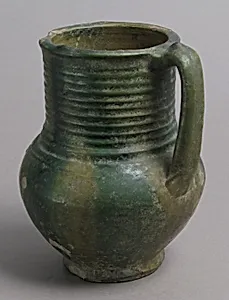
Jug
Unknown Artist
13th–14th century
Medium
Earthenware, glaze
Dimensions
Overall: 6 11/16 x 4 15/16 x 5 3/8 in. (17 x 12.6 x 13.6 cm)
Classification
Ceramics
Culture
French
Department
Medieval Art
Museum
Metropolitan Museum of Art, New York, NY
Credit
Rogers Fund, 1952
Accession Number
52.21.3
Rights
Public Domain
Art Historical Context
This unassuming yet elegant jug, crafted by an unknown French artisan in the 13th–14th century, offers a glimpse into medieval daily life. Made of earthenware coated with a glossy glaze, it measures a compact 6 11/16 x 4 15/16 x 5 3/8 inches, perfect for pouring wine, water, or ale in a household or tavern. Acquired through the Rogers Fund in 1952 and now housed in the Metropolitan Museum of Art's Medieval Art department, it exemplifies the practical ceramics that bridged utility and subtle artistry during France's Gothic era. The use of earthenware—a fired clay body common across medieval Europe—combined with glaze was a significant advancement. The glaze not only sealed the porous surface for waterproofing but also added a luminous sheen, hinting at regional workshops experimenting with lead-based formulas for color and durability. These jugs were mass-produced in northern France, reflecting vibrant pottery traditions influenced by trade routes from Italy and the Islamic world, where glazing techniques had long flourished. As a survivor of centuries, this jug whispers stories of communal feasting and monastic brewing, reminding us how everyday objects embodied cultural ingenuity. Visitors, imagine it gracing a wooden table amid candlelight— a testament to the anonymous makers who shaped medieval France.