
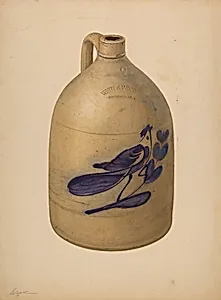
Jug
c. 1941
Medium
watercolor, graphite, and colored pencil on paperboard
Dimensions
overall: 51 x 38.1 cm (20 1/16 x 15 in.)
Classification
Index of American Design
Department
CG-W
Museum
National Gallery of Art, Washington, D.C.
Credit
Index of American Design
Accession Number
1943.8.6302
Rights
Public Domain
Art Historical Context
Behold the elegant *Jug* by Giacinto Capelli, captivating rendering from circa 1941, now housed in the National Gallery of Art. as part of the Index of American Design—a monumental WPA Federal Art Project from the 1930s and early 1940s—this, graphite, and colored pencil work on paperboard (51 x 38.1 cm) meticulously documents an iconic piece of American folk craftsmanship. Capelli's depiction captures the jug's form, glaze, and subtle imperfections, evoking the everyday beauty of early American pottery. The Index of American Design employed over 400 artists to produce more than 15,000 renderings of regional crafts, furniture, and utensils, preserving a visual record of the nation's artistic heritage amid the Great Depression. Capelli, an Italian-American artist skilled in realistic illustration, contributed dozens of such studies, blending technical accuracy with artistic flair. His mixed-media technique—watercolor for luminous color, graphite for fine lines, and colored pencil for texture—elevates the humble jug into a celebration of vernacular design, highlighting influences from European potters and Native American traditions. This artwork invites us to appreciate how ordinary objects embody cultural stories, from frontier hearths to modern collections. A testament to American ingenuity, it reminds visitors of the enduring value of our shared design legacy.
About the Artist
Giacinto Capelli · 1855–present
**Giacinto Capelli** (American, active c. 1935–1942) contributed significantly to the documentation of American material culture through his precise watercolor renderings as part of the Index of American Design, a Federal Art Project under the Works Progress Administration (WPA). Little is known about his early life or formal training, which remains sparsely documented, though his expertise in wat...