
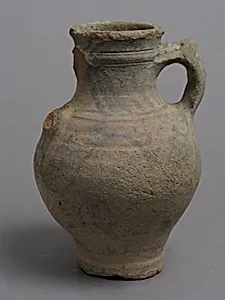
Jug with Grapevines
Unknown Artist
4th–7th century
Medium
Earthenware, slip, oxide pigment
Dimensions
Overall: 7 5/8 x 5 5/16 in. (19.3 x 13.5 cm)
Classification
Ceramics
Culture
Coptic
Department
Medieval Art
Museum
Metropolitan Museum of Art, New York, NY
Credit
Rogers Fund, 1925
Accession Number
25.10.20.238
Rights
Public Domain
Tags
Art Historical Context
This earthenware jug stands with a rounded, swelling body that tapers gently toward a flat base and rises to a short, slightly flared neck. A single looped handle extends from the shoulder to the rim, while the surface bears painted bands of stylized grapevines rendered in muted blue-gray and ocher slips. The decoration wraps around the vessel in loose, curving lines, and areas of wear and small losses reveal the underlying clay, giving the object a softly textured, time-worn appearance. Created between the fourth and seventh centuries in the Coptic tradition of Egypt, the jug belongs to a long history of utilitarian ceramics that combined practical form with simple painted ornament. The grapevine motif, common in works of this period, reflects the agricultural world of the Nile valley while also carrying broader symbolic associations within early Christian communities. Now in the collection of The Metropolitan Museum of Art, the vessel offers visitors a direct glimpse of everyday artistry from late antiquity.