
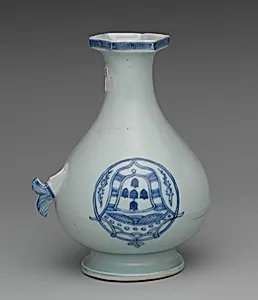
Jug with Portuguese arms
Unknown Artist
ca. 1520–40
Medium
Hard-paste porcelain with cobalt blue under transparent glaze (Jingdezhen ware)
Dimensions
Height: 7 3/8 in. (18.7 cm)
Classification
Ceramics-Porcelain-Export
Culture
Chinese, for Portuguese market
Department
European Sculpture and Decorative Arts
Museum
Metropolitan Museum of Art, New York, NY
Credit
Helena Woolworth McCann Collection, Purchase, Winfield Foundation Gift, 1961
Accession Number
61.196
Rights
Public Domain
Tags
Art Historical Context
This elegant jug, crafted in Jingdezhen, China, around 1520–40, exemplifies early Chinese export porcelain tailored for European tastes. Made from hard-paste porcelain—a durable, translucent material whose formula was a closely guarded Chinese secret until the 18th century—the vessel features cobalt blue underglaze decoration beneath a transparent glaze. Standing just 7⅜ inches tall, its form is practical yet refined, ideal for serving wine or water in a Portuguese household. The standout feature is the coat of arms of an unidentified Portuguese family, a rare customization that highlights the dawn of global trade. By the early 16th century, Portuguese explorers had reached Asia via sea routes, fostering direct exchanges with China through ports like Malacca. Jingdezhen kilns produced these "armorial wares" on commission, blending Chinese mastery with European heraldry to create coveted status symbols. This piece, now in the Metropolitan Museum of Art's European Sculpture and Decorative Arts collection, bridges Eastern artistry and Western prestige. Artistically, the cobalt blue technique—derived from imported cobalt ore—ensures vibrant, unfading color even after centuries. As one of the earliest documented examples of Chinese porcelain with Portuguese arms, it underscores porcelain's role as a currency of diplomacy and luxury in the Age of Exploration, captivating collectors today.