
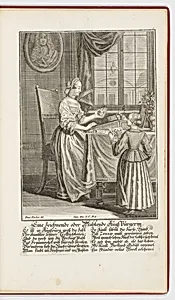
Jungfrauen Arbeit, Kunst, und Fleiss
ca. 1735/40
Medium
plates: engraving
Dimensions
Overall: 14 3/4 x 9 1/16 x 3/16 in. (37.5 x 23 x 0.5 cm)
Classification
Books
Department
Drawings and Prints
Museum
Metropolitan Museum of Art, New York, NY
Credit
Harris Brisbane Dick Fund, 1947
Accession Number
47.23.1
Rights
Public Domain
Tags
Art Historical Context
**Jungfrauen Arbeit, Kunst und Fleiss** (*Virgins' Work, Art, and Diligence*), created 1735–40 by Paul Decker the Younger Martin Engelbrecht, is captivating set of engraved plates preserved in the Metropolitan Museum of's Drawings and Prints department. These detailed engravings, 14¾ x 9¹/₁₆ inches overall, exemplify the technical precision of 18th-century printmaking. Decker, known for his architectural designs, and Engelbrecht, a prolific German engraver, collaborated to produce intricate illustrations that blend artistry with instructional purpose, acquired through the Harris Brisbane Dick Fund in 1947. The title evokes the era's emphasis on virtuous femininity, showcasing patterns for needlework alongside scenes of cooking—key domestic skills taught to young women, or "jungfrauen" (virgins/maids). These engravings likely served as a pattern book, allowing users to replicate elaborate embroidery motifs or culinary setups, reflecting the Rococo style's ornate flourishes and decorative elegance. In the context of Enlightenment Europe, such works promoted diligence and moral education through practical arts, underscoring women's roles in household economy and refinement. A charming window into 18th-century gender ideals, this piece highlights how prints democratized sophisticated designs, making high art accessible for everyday creativity.