
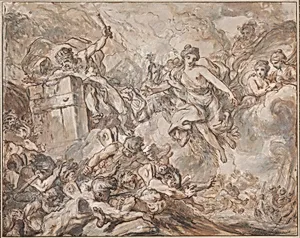
Juno Ordering Aeolus to Unleash the Winds
Medium
Pen and brown ink, brush and brown and gray wash, heightened with white gouache, over black and red chalk underdrawing on light buff paper prepared with a pink wash; framing lines in pen and brown ink
Dimensions
Sheet: 13 × 16 1/8 in. (33 × 41 cm)
Classification
Drawings
Department
Drawings and Prints
Museum
Metropolitan Museum of Art, New York, NY
Credit
Purchase, Charles and Jessie Price Gift, 2013
Accession Number
2013.504
Rights
Public Domain
Tags
Art Historical Context
In the grand tradition of 18th-century French draftsmanship, Louis Jean Jacques Durameau's *Juno Ordering Aeolus Unleash the Winds* (1775) captures a dramatic moment from classical mythology. Here, the powerful goddess Juno commands the wind god Aeolus to release fierce gales, likely referencing episodes from Virgil's *Aeneid* where divine wrath disrupts mortal voyages. Durameau, a prominent Rococo artist known for his elegant history paintings and decorative schemes at royal sites like Fontainebleau, infuses the scene with dynamic movement and theatrical energy, blending mythological grandeur with the refined sensibilities of his era. This exquisite drawing showcases masterful mixed-media techniques: pen and brown ink outline fluid figures, enriched by brush and wash in brown and gray for depth and shadow, heightened with white gouache for luminous highlights, all over a black and red chalk underdrawing on pink-prepared buff paper. Such preparatory works were vital in the workshop tradition, serving as studies for larger paintings, tapestries, or frescoes, highlighting the meticulous planning behind opulent 18th-century commissions. Acquired by The Metropolitan Museum of Art in 2013 through the Charles and Jessie Price Gift, this sheet (13 × 16 1/8 in.) exemplifies the technical virtuosity of Enlightenment-era drawings, bridging Rococo ornamentation and emerging Neoclassicism. Visitors will appreciate its vivid portrayal of gods in fluid poses, evoking the stormy passions of ancient tales.