
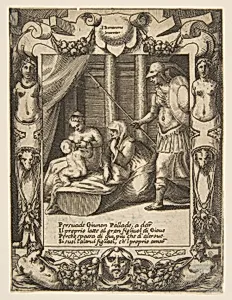
Juno persuading Athena to nurse the young Hercules, set within an elaborate frame, from "Loves, Rages and Jealousies of Juno"
1531–76
Medium
Engraving
Dimensions
sheet: 5 3/8 x 3 15/16 in. (13.7 x 10 cm)
Classification
Prints
Department
Drawings and Prints
Museum
Metropolitan Museum of Art, New York, NY
Credit
The Elisha Whittelsey Collection, The Elisha Whittelsey Fund, 1949
Accession Number
49.97.285
Rights
Public Domain
Tags
Art Historical Context
In the intricate engraving *Juno Persuading Athena to Nurse the Hercules*, created by the Italian master engraver Giulio Bonasone between 1531 and 1576, visitors encounter a vivid mythological tableau from the series *Loves, Rages, and Jealousies of Juno Set within an elaborate frame that enhances its decorative appeal, the scene captures Juno—Roman goddess of marriage and queen of the gods—entreating Athena, the wise warrior goddess, to nurse the infant Hercules. This draws from classical myths where Juno, driven by jealousy over her husband Jupiter's infidelity, schemes against his illegitimate son Hercules, whose superhuman strength famously led to dramatic consequences during such an encounter. Bonasone, a leading figure in 16th-century printmaking, excelled in engraving, a meticulous intaglio technique where lines incised into a metal plate hold ink for detailed impressions. Measuring just 5 3/8 x 3 15/16 inches, this small-scale work exemplifies how engravings democratized art during the Renaissance, allowing intricate reproductions of grand narratives to reach wider audiences beyond paintings. Housed in the Metropolitan Museum of Art's Drawings and Prints department, it highlights themes of divine rivalry, female power, and nudity, as tagged with female nudes, evoking the era's fascination with classical antiquity and humanism. This piece not only showcases Bonasone's technical virtuosity in rendering expressive figures and ornate borders but also reflects the cultural vogue for serialized mythological prints, blending education with ornamentation for collectors' cabinets. A window into Renaissance reinterpretations of Greek and Roman lore!
About the Artist
Giulio Bonasone · 1500–1600
Comment on works: History; Mythology