
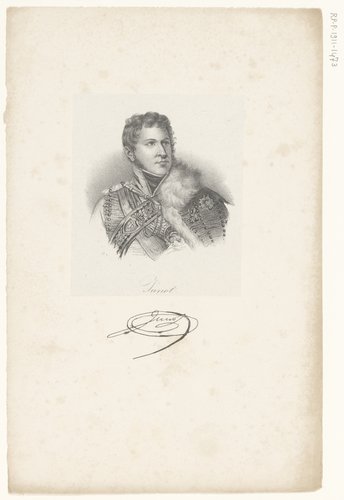
Junot
in of na 1818 - in of voor 1842
Medium
lithography
Dimensions
180; 277
Rights
Public Domain
About this artwork
blad: hoogte 277 mm x breedte 180 mm
Art Historical Context
**Junot**, a striking lithograph from the early 19th century, captures the likeness of Andoche Junot, a prominent French general and close aide to Napoleon Bonaparte. Created by an anonymous artist and published by Veuve Delpech (Naudet)—the widow of the renowned Parisian lithographer François Séraphin Delpech—this print dates to sometime in or after 1818 and before 1842. Measuring 277 mm in height by 180 mm in width, it exemplifies the compact yet detailed format popular for portrait sheets during the post-Napoleonic era. Lithography, the medium here, revolutionized printmaking around 1800 by allowing artists to draw directly on limestone slabs with greasy crayons, producing nuanced tones and textures without carved plates. This technique democratized access to heroic portraits, flooding Europe with affordable images of military figures like Junot, who earned fame (and infamy) for his bold campaigns, including the capture of Lisbon in 1807. Veuve Delpech's studio was a hub for such works, blending Romantic idealism with precise realism. As a cultural artifact, *Junot* reflects the lingering nostalgia for Napoleon's empire amid Bourbon Restoration politics. Visitors will appreciate its subtle gradations—hallmarks of early lithography—that bring history's turbulent figures vividly to life on a single sheet.