
Medium
Engraving
Dimensions
Plate: 11 5/16 × 8 1/2 in. (28.7 × 21.6 cm) Sheet: 13 5/16 × 10 3/16 in. (33.8 × 25.8 cm)
Classification
Prints
Department
Drawings and Prints
Museum
Metropolitan Museum of Art, New York, NY
Credit
Gift of Mrs. John Sichel, 1966
Accession Number
66.747.110
Rights
Public Domain
Art Historical Context
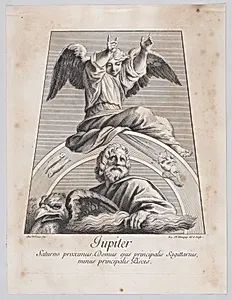
This engraving of Jupiter, created in 1695 by Sir Nicolas Dorigny after designs by Raphael, exemplifies the vital role of reproductive prints in spreading Renaissance masterpieces across Europe. Dorigny, a skilled French engraver active in the Baroque era, translated Raphael’s graceful figures and classical compositions into the precise lines of engraving, a medium prized for its ability to capture intricate detail and tonal depth. Such works allowed viewers far from Italy to study the High Renaissance master’s vision of mythological subjects. Raphael’s original designs often drew on antique sources to portray gods with dignified authority, and Dorigny’s faithful yet interpretive rendering helped sustain that legacy well into the eighteenth century. Housed today in the Metropolitan Museum’s Department of Drawings and Prints, this sheet—measuring just over eleven inches in height—reminds us how printmaking democratized art, turning private frescoes and paintings into widely circulated treasures that shaped taste and scholarship for generations.