
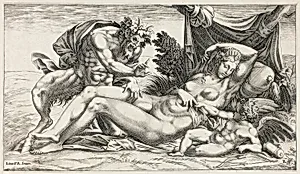
Jupiter and Antiope
1550/59
Medium
Engraving on ivory laid paper, edge-mounted to ivory laid paper
Dimensions
Image: 16.2 × 28.6 cm (6 7/16 × 11 5/16 in.); Sheet: 16.6 × 28.8 cm (6 9/16 × 11 3/8 in.); Secondary support: 25.2 × 36.7 cm (9 15/16 × 14 1/2 in.)
Classification
engraving
Department
Prints and Drawings
Museum
Art Institute of Chicago
Accession Number
182410
Rights
Public Domain
About this artwork
René Boyvin’s Jupiter and Antiope is one of his anatomically ambitious reproductive prints based on the work of Luca Penni. It illustrates a story from Greek mythology. Boyvin depicted Antiope resting in a classical pose, with her arm overhead, as Jupiter, in the form of a satyr, stands over her, gesturing to the putto at Antiope’s side not to wake her. The figures are characterized by their accentuated muscles and distorted anatomy, a style typical to the School of Fontainebleau, whose artists ...
Art Historical Context
René Boyvin's *Jupiter and Antiope created between 1550 and 1559, captures a seductive mythological moment from Ovid's *Metamorphoses*. Here, the king of the gods, Jupiter, disguises himself as a sat to woo the mortal Antiope, embodying the era's fascination with classical tales of divine passion and transformation. As a leading French engraver of the Mannerist period, Boyvin worked in the orbit of the Fontainebleau, translating the elegant, elongated figures and intricate compositions of Italian masters like Rosso Fiorentino into precise print form. This engraving on luxurious ivory laid paper exemplifies 16th-century reproductive printmaking, a technique where metal plates were incised with fine lines to produce detailed, reproducible images. The medium's durability and fine texture allowed for subtle tonal gradations and textures, making it ideal for disseminating sophisticated art to collectors across Europe. Boyvin's meticulous burin work highlights the interplay of light and shadow, enhancing the scene's erotic tension and dynamic poses. Housed in the Art Institute of Chicago's Prints and Drawings Department, this work reflects the Renaissance boom in prints as affordable luxury items, bridging courtly patronage and broader audiences. Its small scale—about 16 x 29 cm—invites intimate viewing, revealing the technical virtuosity that made engravings a cornerstone of artistic innovation in mid-16th-century France.
About the Artist
René Boyvin · 1525–1580
French, Angers ca. 1525–1598 or 1625/6 Angers