
Jupiter and Ganymede
1645–98
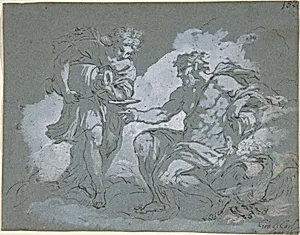
Medium
Pen and brown ink, heightened with white on blue paper
Dimensions
sheet: 5 3/4 x 7 3/8 in. (14.6 x 18.7 cm)
Classification
Drawings
Department
Drawings and Prints
Museum
Metropolitan Museum of Art, New York, NY
Credit
Harry G. Sperling Fund, 2003
Accession Number
2003.497
Rights
Public Domain
Tags
Art Historical Context
Johan Carl Loth's *Jupiter and Ganymede*, created between 1645 and 1698, captures a dramatic moment from classical mythology in a masterful preparatory drawing. Using pen and brown ink heightened with white on blue paper Loth depicts the god Jupiter, disguised as an eagle,oping to abduct the beautiful Trojan youth Ganymede, recounted in Ovid's *Metoses*. This tale symbolizes divine desire and the elevation of mortal beauty to the heavens, where Ganymede serves as cupbearer to the gods. A prominent Baroque artist of German origin, Loth trained in Venice under masters like Pietro Liberi, absorbing the dramatic lighting and dynamic compositions of Titian and Tintoretto. His drawings, like this one (measuring just 5 3/4 x 7 3/8 inches), served as vital studies for larger paintings, showcasing his fluid line work and expert use of chiaroscuro effects through ink washes and white highlights. The blue paper enhances the luminous quality, a technique popular in 17th-century Italian workshops for evoking depth and movement. Acquired by the Metropolitan Museum of Art through the Harry G. Sperling Fund in 2003, this intimate sheet highlights Loth's skill in blending myth with sensual energy, reflecting Baroque art's emphasis on emotion and grandeur. It's a window into the creative process of an artist who bridged Northern and Venetian traditions, inviting viewers to ponder timeless themes of power and beauty.