
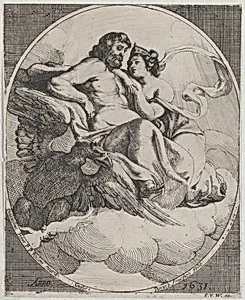
Jupiter and Juno seated on clouds, with an eagle holding thunderbolts below at left
Medium
Etching; second state of two (Hollstein)
Dimensions
Sheet (Trimmed): 7 in. × 5 11/16 in. (17.8 × 14.4 cm)
Classification
Prints
Department
Drawings and Prints
Museum
Metropolitan Museum of Art, New York, NY
Credit
The Elisha Whittelsey Collection, The Elisha Whittelsey Fund, 1951
Accession Number
51.501.7687
Rights
Public Domain
Tags
Art Historical Context
Behold this captivating etching, *Jupiter and Juno seated on, with an eagle holdingbolts below at left a collaborative masterpiece from 1631 Peter Paul Rubens alongside engravers Willem Panneels Frans van den Wynga. The scene bursts with classical mythology: the king and queen of the gods, Jupiter and Juno, recline majestically amid swirling clouds, while a fierce eagle clutches thunderbolts below—a symbol of Jupiter's power and dominion. At just 7 by 5 11/16 inches, this intimate print packs the grandeur of Rubens' Baroque vision into a portable format. Rubens, the Flemish Baroque titan, masterminded such reproductive prints to disseminate his designs across Europe, blending dramatic movement, rich contrasts, and sensual forms inspired by antiquity. Created during his prolific Antwerp period, when he served nobility and courts, this work reflects the era's fascination with Olympian deities, evoking tales from Ovid and Virgil. The etching's second state (per Hollstein) likely features refined details, showcasing the meticulous technique of intaglio printing that allowed intricate shading and texture. Housed in the Metropolitan Museum of Art's Elisha Whittelsey Collection, this print highlights how 17th-century innovations in printmaking democratized high art, letting collectors savor Rubens' theatrical energy without original oil paintings. A testament to collaboration and mythology's enduring allure!