
Jupiter and Mercury with Philemon and Baucis
c. 1650
Medium
Engraving on paper
Dimensions
Plate: 48.7 × 56.5 cm (19 3/16 × 22 1/4 in.); Sheet: 49.4 × 56.7 cm (19 1/2 × 22 3/8 in.)
Classification
engraving
Department
Prints and Drawings
Museum
Art Institute of Chicago
Accession Number
39282
Rights
Public Domain
About this artwork
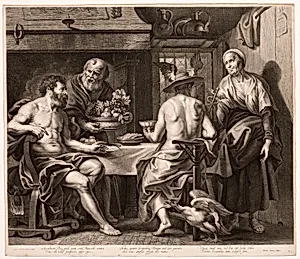
In Greek mythology, the gods Jupiter and Mercury disguised themselves as mortals to travel through the ancient kingdom of Phrygia. On their way, they were refused hospitality by almost every household, but Philemon and Baucis, a pious old couple of modest means, selflessly welcomed them into their humble home. The gods rewarded the couple while punishing their neighbors. This engraving by Nicolaes Lauwers is based on a painting by Jacob Jordaens, who depicted the subject more than once. Working ...
Art Historical Context
This engraving by Flemish printmaker Nicolaes Lauwers, created around 1650, brings to life a beloved episode from Ovid’s Metamorphoses. The scene depicts the gods Jupiter and Mercury receiving humble hospitality from the elderly couple Philemon and Baucis, who unknowingly welcome divine guests into their modest home. The story underscores themes of piety, generosity, and reward, popular in seventeenth-century Europe as moral lessons drawn from classical antiquity. Lauwers worked in the reproductive engraving tradition, translating painted compositions into detailed prints on paper. This medium allowed the image to reach a broader audience beyond the original painting’s owners, spreading both artistic designs and narrative subjects across Europe. The large plate size—nearly 49 by 57 centimeters—demonstrates the technical skill required to render dramatic gestures, textures, and architectural details through incised lines. Today the work resides in the Art Institute of Chicago’s Prints and Drawings collection, where it offers visitors a window into how classical stories continued to shape visual culture in the Baroque era. Its careful craftsmanship highlights engraving’s role in preserving and circulating important artistic ideas for generations.