
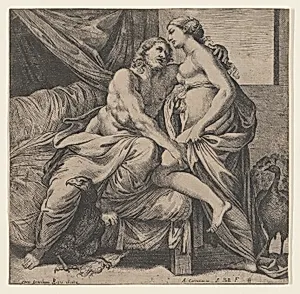
Jupiter embracing Juno, from the Farnese Palace
Medium
Etching; first state of two
Dimensions
Sheet (trimmed): 8 7/8 × 5 7/8 in. (22.5 × 15 cm)
Classification
Prints
Department
Drawings and Prints
Museum
Metropolitan Museum of Art, New York, NY
Credit
Joseph Pulitzer Bequest, 1917
Accession Number
63.579.18
Rights
Public Domain
Tags
Art Historical Context
In the grand tradition of Renaissance and Baroque mythology, *Jupiter Embracing Juno, from the Farnese Palace captures a tender moment between the king and queen of the Roman gods. Created as an etching in 1641 by Jacques Belly after designs by the celebrated Carracci brothers—Annale and Agostino—this print reproduces a fresco from the opulent Farnese Palace in Rome. The Carraccis, pioneers of the Bolognese school, infused their work with naturalism and emotional depth, moving away from Mannerist exaggeration toward a more humanistic style that influenced generations of artists. This first-state etching, measuring a compact 8 7/8 × 5 7/8 inches, showcases the intricate line work typical of the medium, where acid bites into a metal plate to create rich tonal contrasts. Peacocks, sacred to Juno and symbols of immortality and beauty, likely grace the composition, adding layers of classical symbolism. As a rare early impression before later revisions, it preserves the artists' original vision with exceptional clarity. Housed in the Metropolitan Museum of Art's Drawings and Prints department through the Joseph Pulitzer Bequest of 1917, this print bridges the monumental frescoes of the Farnese ceiling—commissioned for Cardinal Odoardo Farnese—with intimate collector's art, inviting us to savor ancient myths in a portable form.
About the Artist
Agostino Carracci|Annibale Carracci|Jacques Belly · 1557–1602
Agostino left his profession as a tailor to become an artist. His earliest works were engravings, which was an extremely profitable practice and he was famed for having attained new heights of perfection. He was also a skilled painter and collaborated with his famous relations on various commisions. Comment on works: Religious; Portraits.