
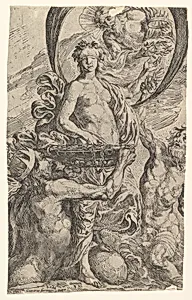
Jupiter, Pluto and Neptune Offering their Riches to Fortune
Medium
Etching
Dimensions
9 15/16 x 6 1/8 in. (25.2 x 15.6 cm) (clipped impression)
Classification
Prints
Department
Drawings and Prints
Museum
Metropolitan Museum of Art, New York, NY
Credit
Purchase, Joseph Pulitzer Bequest, 1917
Accession Number
17.50.15-35
Rights
Public Domain
Tags
Art Historical Context
In the early Baroque era of 1624, French artists Pierre Brebiette and Vignon collaborated on this etching, *Jupiter, Pluto, and Offering their Riches to*. The print depicts the mighty Roman gods—Jupiter of the skies, Neptune of the seas, and Pluto the underworld—presenting their treasures to the enigmatic goddess Fortune, symbolizing the fleeting nature power and wealth. This allegorical theme, rooted in classical mythology, reflects the period's fascination with fate's unpredictability, popular in French art amid the opulent yet turbulent reign of Louis XIII. Vignon, known for his dramatic Baroque style blending Mannerist elegance with dynamic energy, and Brebiette, a skilled engraver, masterfully captured the gods' imposing forms and cascading riches in intricate lines. Etching, the chosen medium, involved biting acid into a metal plate to create fluid, expressive marks ideal for mythological narratives. At just under 10 by 6 inches (a clipped impression), this intimate print allowed for widespread dissemination of grand ideas, making classical grandeur accessible beyond elite patrons. Acquired by The Metropolitan Museum of Art in 1917 through the Joseph Pulitzer Bequest, this work exemplifies 17th-century printmaking's role in democratizing art, inviting viewers to ponder: even gods bow to Fortune's wheel.
About the Artist
Pierre Brebiette|Claude Vignon · 1598–1642
Pierre Brébiette (c. 1598–c. 1642) was a French painter and etcher whose elegant, sensuous treatment of classical mythology and allegory earned him a significant reputation in early seventeenth-century Paris. Born in Mantes-sur-Seine, Brébiette traveled to Italy as a young man and lived and worked in Rome from around 1617 to approximately 1625, absorbing the influences of ancient sculpture, Renais...