
Justice
1650 - 1651
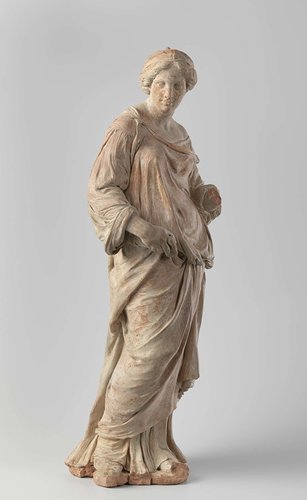
Medium
terracotta
Dimensions
88
Rights
Public Domain
About this artwork
height 88 cm
Art Historical Context
**Justice** by Artus Quinus I (1609–1668) is a striking terracotta sculpture from 1650–1651, standing at 88 cm. Created during the Dutch Golden Age, this work exemplifies the Flemish sculptor's mastery in the Baroque style, known for its dramatic movement and emotional intensity. Quellinus, part of a renowned Antwerp family of artists, brought southern European flair to the Netherlands after settling in Amsterdam. Likely a *bozzetto*—a small-scale preparatory model—this terracotta piece served as a study for larger stone sculptures. Terracotta, a versatile fired clay, allowed Quellinus to rapidly model fluid forms and test compositions before committing to marble or sandstone. Its medium highlights 17th-century sculptural techniques, where such models were essential for monumental civic projects. Personifying Justice, the figure embodies ideals of equity and authority, a common motif in Baroque public art symbolizing stable governance. Quellinus contributed to the grand decorations of Amsterdam's Town Hall (now Royal Palace), where allegorical sculptures like this underscored the city's prosperity and moral order. A testament to his skill, *Justice* invites visitors to appreciate the tactile energy of clay in capturing timeless virtues.