
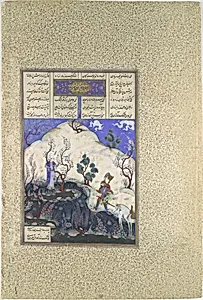
"Kai Khusrau is Discovered by Giv", Folio 210v from the Shahnama (Book of Kings) of Shah Tahmasp
ca. 1525–30
Medium
Opaque watercolor, ink, silver, and gold on paper
Dimensions
Painting: H. 11 1/8 in. (28.3 cm) W. 7 7/16 in. (18.9 cm) Page: H. 18 9/16 in. (47.1 cm) W. 12 1/8 in. (30.8 cm) Mat: H. 22 in. (55.9 cm) W. 16 in. (40.6 cm)
Classification
Codices
Department
Islamic Art
Museum
Metropolitan Museum of Art, New York, NY
Credit
Gift of Arthur A. Houghton Jr., 1970
Accession Number
1970.301.32
Rights
Public Domain
Tags
Art Historical Context
This exquisite folio from the Shahnama (Book of Kings) of Shah Tahmasp captures a pivotal moment from the Persian epic poem by Abu’l Qasim Firdausi. The scene depicts Giv, a loyal hero, discovering the prince Kai Khusrau among shepherds—an event that sets the stage for the prince’s rise to the throne. Created around 1525–30 during the Safavid dynasty, the painting reflects the manuscript’s grand ambition to celebrate Iran’s legendary past through lavish illustration. Painted by the artist Qadimi in opaque watercolor, ink, silver, and gold on paper, the work exemplifies the refined techniques of Persian miniature painting. Delicate brushwork and luminous metallic accents bring the figures and horses to life against a richly patterned landscape, while the tall, narrow format suits the codex’s elegant page design. Such manuscripts were prized at the Safavid court as symbols of cultural prestige and royal patronage. Housed today at the Metropolitan Museum of Art, this folio offers visitors a window into 16th-century Persian storytelling and artistic mastery. Its vibrant colors and narrative detail continue to enchant, highlighting the enduring power of the Shahnama to blend history, myth, and visual splendor.
About the Artist
Abu'l Qasim Firdausi|Qadimi · 935–1020
Abu'l Qasim Firdausi, born around 940 in the village of Paj near Tus in Khorasan (modern-day Iran), emerged from a family of landed gentry known as dehqans, who preserved ancient Iranian oral traditions amid the cultural renaissance of the Samanid Empire. Little is documented about his early life or formal training, though he likely received a basic education including Arabic literacy, immersing h...