
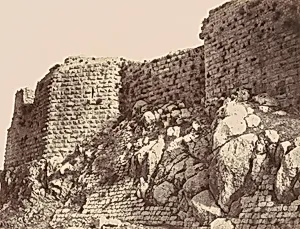
Kalaat-Esch-Schekif, Beaufort—Vue partielle de l'enceinte sud-ouest (Partial view of the south-west enclosure)
1860
Medium
albumen print
Dimensions
image/sheet: 21.3 × 27.7 cm (8 3/8 × 10 7/8 in.) mount: 45.2 × 60.7 cm (17 13/16 × 23 7/8 in.)
Classification
Photograph
Department
CPH
Museum
National Gallery of Art, Washington, D.C.
Credit
Gift of Robert B. Menschel
Accession Number
2022.154.6
Rights
Public Domain
Art Historical Context
Step into the sun-drenched ruins of Kalaat-Esch-Schekif, also known as Beaufort Castle, through Louis De Clercq's captivating 1860 albumen print. This partial view of the south-west enclosure captures the imposing stone walls of this Crusader fortress perched dramatically atop a Lebanese hill overlooking the Litani River. De Clercq, a pioneering French photographer and diplomat, documented such Levantine landmarks during his travels in the 1850s and 1860s, preserving architectural marvels that blended Byzantine, Arab, and Crusader influences. Created via the albumen process—photography's gold standard of the era, using egg whites to bind light-sensitive silver salts onto paper—this 21.3 × 27.7 cm image exemplifies early documentary precision. Its rich tonal range and sharp details reveal weathered fortifications scarred by centuries of sieges, from Saladin's forces to Ottoman rule. Housed in the National Gallery of Art's photography collection (gift of Robert B. Menschel), the print bridges 19th-century exploration with modern appreciation, offering visitors a window into a strategically vital site that symbolized power in the Holy Land. De Clercq's work fueled Europe's fascination with Orientalism, blending scientific accuracy with aesthetic allure, and this piece stands as a testament to photography's power to immortalize history's echoes.