
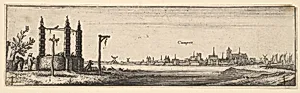
Kampen
1642–44
Medium
Etching; second state of two
Dimensions
Sheet: 1 7/8 × 6 7/16 in. (4.7 × 16.4 cm)
Classification
Prints
Department
Drawings and Prints
Museum
Metropolitan Museum of Art, New York, NY
Credit
Gift of Robert Hartshorne, 1918
Accession Number
18.48.1-10
Rights
Public Domain
Tags
Art Historical Context
Wenceslaus Hollar's *Kampen* (1642–44) captures a panoramic view of the Dutch town of Kampen, along the IJssel River This intimate etching, measuring just 1 7/8 × 6 7/16 inches, showcases Hollar's mastery as a Bohemian-born printmaker who fled religious strife in Europe to work in Antwerp and London. Amid the turmoil of the Thirty Years' War and emerging Dutch Golden Age, Hollar documented urban scenes with exquisite precision, blending architecture, waterways, and bustling human figures to evoke daily life. Rendered in etching—the second state of two—this print highlights Hollar's virtuoso technique. Etching allowed fluid, intricate lines that mimic the sparkle of river reflections and the texture of period boats and buildings. The narrow format emphasizes the river's flow, drawing viewers into a lively riverside tableau populated by townsfolk, a nod to the thriving trade hubs of the Netherlands. Housed in the Metropolitan Museum of Art's Drawings and Prints department (gift of Robert Hartshorne, 1918), *Kampen* exemplifies Hollar's prolific output of over 2,500 works, prized for their topographical accuracy and artistic finesse. It's a window into 17th-century Europe, inviting us to linger on its delicate details.
About the Artist
Wenceslaus Hollar · 1607–1677
Wenceslaus Hollar (1607-1677) was a prolific Bohemian etcher who became one of the most accomplished printmakers of the seventeenth century. Born in Prague, he trained under Matthäus Merian in Frankfurt before entering the service of Thomas Howard, Earl of Arundel, in 1636. Hollar spent most of his career in England, where he produced approximately 2,740 etchings documenting an extraordinary range...