
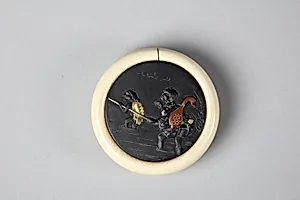
Kappa Leading Blind Man
Unknown Artist
19th century
Medium
Ivory with bronze disk inlaid with gold
Dimensions
Diam. 1 5/8 in. (4.1 cm); Th. 1/2 in. (1.3 cm)
Classification
Netsuke
Culture & Period
Japan · Edo (1615–1868) or Meiji period (1868–1912)
Department
Asian Art
Museum
Metropolitan Museum of Art, New York, NY
Credit
Bequest of Stephen Whitney Phoenix, 1881
Accession Number
81.1.51
Rights
Public Domain
Tags
Art Historical Context
This exquisite netsuke, titled *Kappa Leading Blind Man is a masterful example of 19th-century Japanese ivory carving from the Edo (16151868) or earlyiji (1868–1912) period. Crafted by an unknown artist, it measures just 1 5/8 inches in and 1/2 inch thick, showcasing the intricate miniaturization typical of netsuke—small toggles worn on kimono sashes to secure inro pouches. The medium of ivory, prized for its smooth translucency, is enhanced by a bronze disk inlaid with gold, likely representing the kappa's signature head dish, a vessel of water essential to the creature's mythical power. The subject draws from Japanese folklore, where the kappa is a mischievous water yokai (spirit) with webbed hands, a turtle-like shell, and a penchant for pranks, including leading the blind astray or wrestling villagers. This carved scene captures a moment of sly guidance, blending humor and the supernatural in everyday life. Netsuke like this were not mere ornaments but functional art, reflecting the ukiyo-e spirit of Edo Japan's urban culture, where artisans competed in fantastical designs. Housed in the Metropolitan Museum of Art's Asian Art Department (Bequest of Stephen Whitney Phoenix, 1881), it highlights the technical virtuosity of Japanese sculptors—rendering dynamic figures, textures, and expressions in ivory's unforgiving surface. A delightful window into yokai lore, it invites visitors to ponder the playful boundaries between human and otherworldly realms.