
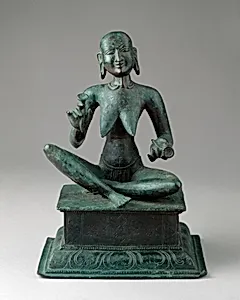
Karaikkal Ammaiyar, Shaiva Saint
Unknown Artist
ca. late 13th century
Medium
Copper alloy
Dimensions
H. 9 1/8 in. (23.2 cm); W. 6 1/2 in. (16.5 cm); D. 5 1/4 in. (13.3 cm)
Classification
Sculpture
Culture & Period
India (Tamil Nadu) · Chola period (880–1279)
Department
Asian Art
Museum
Metropolitan Museum of Art, New York, NY
Credit
Purchase, Edward J. Gallagher Jr. Bequest, in memory of his father, Edward Joseph Gallagher, his mother, Ann Hay Gallagher, and his son, Edward Joseph Gallagher III, 1982
Accession Number
1982.220.11
Rights
Public Domain
Tags
Art Historical Context
This exquisite copper alloy sculpture from late 13th-century Tamil Nadu captures Karaikkal Ammaar, one of the most revered female Shaiva saints of South India during the Chola period (–1279). Standing just over 9 inches tall, the bronze depicts the saint in a dynamic, emaciated form—often shown as a devoted ascetic who renounced worldly beauty to worship Shiva eternally. Her nude figure, paired with musical instruments like theal (a arched harp), symbolizes her ecstatic bhakti devotion through poetry and song, as celebrated in Tamil Shaivite literature. Chola bronzes, crafted via the lost-wax technique, represent the pinnacle of South Indian metalwork, with their fluid lines, intricate casting, and spiritual intensity. This piece exemplifies the era's mastery, where portable icons fueled temple rituals and personal piety. Karaikkal Ammaiyar, a 6th-century poet among the 63 Nayanmar saints, embodies female spiritual power, challenging norms by transforming into a gaunt, otherworldly figure at Shiva's feet. Housed in the Metropolitan Museum of Art's Asian Art collection, this sculpture invites reflection on devotion's transformative power, blending artistry with profound cultural reverence for Shaivism in medieval India.