
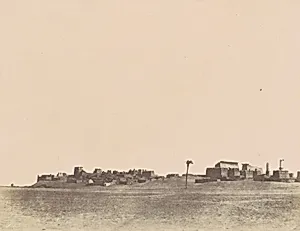
Karnak, Temple du Sud
c. 1854
Medium
salted paper print
Dimensions
image/sheet: 23.3 × 30.3 cm (9 3/16 × 11 15/16 in.) mount: 39.7 × 56.3 cm (15 5/8 × 22 3/16 in.)
Classification
Photograph
Department
CPH
Museum
National Gallery of Art, Washington, D.C.
Credit
Gift of Paul Sack
Accession Number
2016.185.2
Rights
Public Domain
Art Historical Context
In the mid-19th century, photography emerged as a revolutionary tool for documentation, American-born archaeologist photographer John Beasley Greene to Egypt, capturing the grandeur of ancient sites with pioneering precision. *Karnak, Temple du Sud* (c. 1854) depicts a section of the vast Karnak Temple complex in Luxor, one of the largest religious structures ever built, dedicated to the god Amun. Greene's image freezes the monumental columns and hieroglyph-adorned walls of the southern temple, offering visitors a window into pharaonic Egypt just as European explorers were rediscovering its wonders. Printed as a salted paper print—a delicate early process invented by William Henry Fox Talbot—this 23.3 × 30.3 cm photograph exemplifies the calotype era's soft, warm tones and subtle gradations. The paper was salted with sodium chloride, sensitized with silver nitrate, and contact-printed from a paper negative, yielding an intimate, painterly quality ideal for architectural subjects. Though prone to fading, such prints were vital for preserving sites vulnerable to time and tourism. Greene's work, part of the National Gallery of Art's collection (gift of Paul Sack), holds historical significance as one of the earliest photographs of Karnak, bridging archaeology and art. It reflects the era's passion for Orientalism and scientific recording, inviting us to marvel at antiquity through 19th-century eyes.