
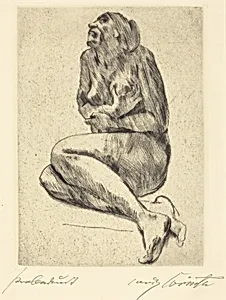
Kauernder weiblicher akt (Crouching Female Nude)
1914
Medium
drypoint and aquatint in black
Dimensions
plate: 21.8 x 15.8 cm (8 9/16 x 6 1/4 in.) sheet: 39.5 x 29 cm (15 9/16 x 11 7/16 in.)
Classification
Department
CG-W
Museum
National Gallery of Art, Washington, D.C.
Credit
Gift of Dr. Toni G. Marcy
Accession Number
2000.105.3
Rights
Public Domain
Art Historical Context
Lovis Corinth's *Kauernder weib akt (Crouching Nude)*, created in 1914, captures the artist's late-career fascination with the human form through intimate, expressive printmaking. A leading figure in German Expressionism and a key member of the Berlinession, Corinth produced this drypoint and aquint just as World War I erupted, amid his own personal challenges following a stroke in 1911. His nudes often explored vulnerability and vitality, rendered here with a crouched figure that emphasizes dynamic tension and psychological depth. The medium—drypoint for its spontaneous, burr-rich lines and aquatint for subtle tonal gradations—lends the work a painterly quality rare in prints. Measuring a modest plate size of 21.8 x 15.8 cm, it showcases Corinth's mastery in translating bold brushwork into etched precision, evoking the soft modeling of flesh against shadow. This combination allowed for velvety textures and dramatic contrasts, bridging traditional print techniques with modernist immediacy. Housed in the National Gallery of Art as a gift from Dr. Toni G. Marcy, this piece exemplifies Corinth's innovative approach to the female nude, inviting viewers to appreciate the body's raw beauty and the era's shifting artistic freedoms. A gem for print enthusiasts, it reveals how technical innovation amplified emotional resonance in early 20th-century art.
About the Artist
Lovis Corinth · 1858–1925
Lovis Corinth, born Franz Heinrich Louis on July 21, 1858, in Tapiau, East Prussia (now Gvardeysk, Russia), to a tanner father, displayed prodigious drawing talent from childhood. He began formal training at the Königsberg Academy in 1876, then moved to the Academy of Fine Arts in Munich from 1880 to 1884, studying under Ludwig von Löfftz and briefly Franz von Defregger, where he absorbed a Realis...