
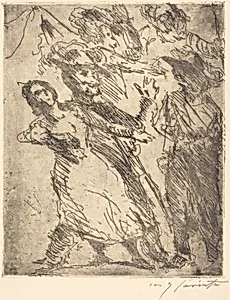
Kavaliere mit einer frau (Cavaliers with a Woman)
c. 1923
Medium
etching in black on Van Gelder Zonen laid paper
Dimensions
plate: 25.7 x 20.8 cm (10 1/8 x 8 3/16 in.) sheet: 40 x 29.2 cm (15 3/4 x 11 1/2 in.)
Classification
Department
CG-W
Museum
National Gallery of Art, Washington, D.C.
Credit
Gift of Dr. Toni G. Marcy
Accession Number
1997.118.1
Rights
Public Domain
Art Historical Context
Lovis Corinth's *Kavaliere mit einer (Cavaliers with a Woman)*, around 1923, captures the artist's late-career mastery in printmaking. This intimate etching in black ink on Van Gelder Zonen laid— a premium Dutch handmade sheet prized for its texture and durability—measures a modest plate size of 25.7 x 20.8 cm. The title evokes a lively social scene, likely featuring gallant gentlemen and a woman in a moment of flirtation or camaraderie, rendered with Corinth's characteristic bold lines and expressive energy. A towering figure in German art, Corinth (1858–1925) began as a Realist and Impressionist before embracing Expressionism. By the 1920s, following a debilitating stroke in 1911, his work grew more vigorous and psychologically charged. Etching allowed him to explore dynamic compositions with incisive detail, using acid to bite intricate lines into a metal plate for rich tonal contrasts. This print exemplifies his shift toward raw, emotive forms, bridging painting and graphics in Weimar-era Germany. Housed in the National Gallery of Art's print collection (Department CG-W) as a gift from Dr. Toni G. Marcy, this piece invites visitors to appreciate Corinth's technical innovation and the era's cultural vibrancy. Its small scale belies a profound intimacy, perfect for savoring up close.
About the Artist
Lovis Corinth · 1858–1925
Lovis Corinth, born Franz Heinrich Louis on July 21, 1858, in Tapiau, East Prussia (now Gvardeysk, Russia), to a tanner father, displayed prodigious drawing talent from childhood. He began formal training at the Königsberg Academy in 1876, then moved to the Academy of Fine Arts in Munich from 1880 to 1884, studying under Ludwig von Löfftz and briefly Franz von Defregger, where he absorbed a Realis...