
Keldergewelf
1825 - 1882
Medium
etching
Dimensions
105; 128
Rights
Public Domain
About this artwork
ets; proefdruk
Art Historical Context
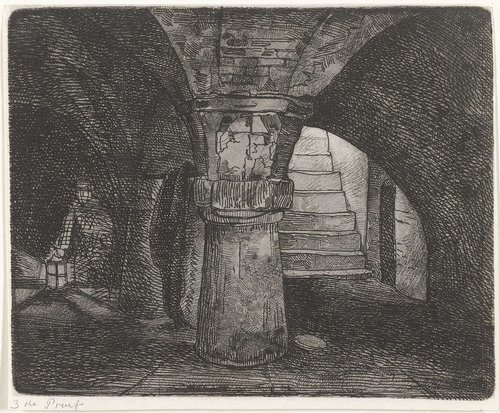
**Keldergewelf** a delicate etching by Dutch artist Jacobus Ludovic Cornet, created sometime between 1825 and1882. Measuring just 105 mm high by 128 mm wide, this print captures the title's subject—a "keldergewelf," or vaulted cellar—evoking the shadowy, architectural wonders of the Netherlands' historic underbelly. Cornet, active in the 19th, specialized in precise renderings of Gothic and medieval structures, blending Romantic nostalgia with meticulous observation. As an etching (denoted "ets" in Dutch), the work showcases the medium's power: acid biting into a metal plate to create fine lines and textures that mimic stone arches and dim light. This "proefdruk," or proof print, is especially intriguing—an early trial impression pulled before the final edition, offering a glimpse into Cornet's iterative process. Proofs like this were prized by collectors for their raw quality and subtle variations. In the context of 19th-century Dutch art, **Keldergewelf** reflects a growing fascination with national heritage amid rapid modernization. Cornet's etchings preserved vanishing architectural details, making hidden spaces like cellars accessible to a wider audience through affordable prints. A charming window into everyday history! (198 words)
About the Artist
Jacobus Ludovicus Cornet · 1815–1882
Jacobus Ludovicus Cornet (1815–1882) was a Dutch painter, draughtsman, and museum curator whose career bridged artistic practice and cultural preservation. Born in Leiden in 1815, Cornet devoted his life to documenting Dutch history and culture through his paintings and drawings while simultaneously working to preserve the nation's artistic heritage as head of Leiden's Prentenkabinet (Prints Cabin...