
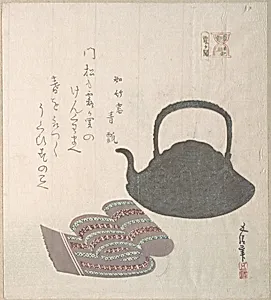
Kettle and Sash
Medium
Woodblock print (surimono); ink and color on paper
Dimensions
8 1/8 x 7 1/4 in. (20.6 x 18.4 cm)
Classification
Prints
Culture
Japan
Department
Asian Art
Museum
Metropolitan Museum of Art, New York, NY
Credit
H. O. Havemeyer Collection, Bequest of Mrs. H. O. Havemeyer, 1929
Accession Number
JP2147
Rights
Public Domain
Tags
Art Historical Context
Nestled in the Metropolitan Museum of Art's Asian Art collection, *Kettle and Sash* is a delicate woodblock print (surono) by the Japanese artist Sunayama Gosei. Created in an unknown date during Japan's Edo period or later, this intimate work measures just 8 1/8 x 7 1/4 inches, everyday objects—a humble kettle and flowing sash—rendered in vibrant ink and color on paper Part of the prestigious H. O. Havemeyer Collection, bequeathed 1929, it the discerning taste of early 20th-century American collectors for Japanese artistry. Surimono, meaning "printed things," were privately commissioned prints produced for special occasions like New Year's greetings or poetry gatherings, often in limited editions for elite patrons. Unlike mass-produced ukiyo-e, they employed exquisite techniques: fine carving for sharp details, subtle color gradations (bokashi), and sometimes embossing or mica for texture. Sunayama Gosei, working in this refined tradition, elevates mundane items into poetic still lifes, inviting viewers to appreciate the beauty in simplicity—a hallmark of Japanese aesthetics like wabi-sabi. This charming piece offers a window into Japan's printmaking golden age, where art bridged poetry, nature, and daily life. Spot the kettle's gleaming metallic sheen and the sash's graceful folds, evoking quiet domestic harmony. A true gem for lovers of Asian prints!