
Key
Unknown Artist
1st–7th century
Medium
Copper alloy, iron
Dimensions
Overall: 2 15/16 x 1/2 x 7/8 in. (7.5 x 1.3 x 2.2 cm)
Classification
Metalwork-Bronze
Culture
Roman
Department
Medieval Art
Museum
Metropolitan Museum of Art, New York, NY
Credit
Purchase, De Souhami Collection, Rogers Fund, 1906
Accession Number
06.176.60
Rights
Public Domain
Art Historical Context
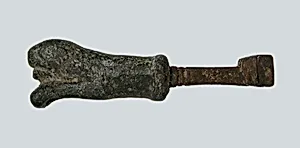
This unassuming yet intriguing Roman key, crafted from copper alloy and iron between the 1st and 7th centuries, a glimpse into the everyday ingenuity of late antiquity. Measuring just under 3 inches long, its compact form—likely designed for a small padlock or chest—highlights the practical craftsmanship of Roman metalworkers. Housed in the Metropolitan Museum of Art's Art department (acquired in 1906), it exemplifies metalwork techniques such as casting and forging, where the durable copper alloy provided corrosion resistance, while iron added strength. In Roman culture, keys were more than tools; they symbolized authority, privacy, and security in an era of expanding trade and urban life. This artifact spans the transition from the classical Roman Empire to early Byzantine influences, reflecting evolving locksmithing practices amid social changes. Though functional, its survival underscores the technical prowess of artisans who produced thousands of such items for homes, temples, and tombs. Visitors will appreciate how this humble object bridges the gap between utility and history, reminding us that even the smallest relics reveal the rhythms of ancient daily life.