
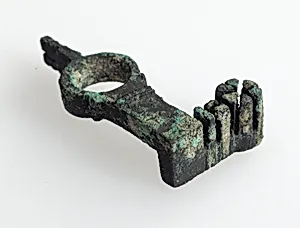
Key
Unknown Artist
1st–3rd century
Medium
Copper alloy, iron
Dimensions
Overall: 2 x 1 3/16 x 1/2 in. (5.1 x 3 x 1.2 cm)
Classification
Metalwork-Copper alloy
Culture
Roman
Department
Medieval Art
Museum
Metropolitan Museum of Art, New York, NY
Credit
Rogers Fund, 1910
Accession Number
10.100.159
Rights
Public Domain
Art Historical Context
This unassuming Roman key, crafted from copper alloy and iron around the 1st to 3rd century CE, offers a tangible glimpse into everyday life during the height of the Roman Empire. Measuring over 2 inches long, its petite size suggests it secured personal possessions like chests, doors, or small cabinets—practical tools for a society where property and privacy were increasingly valued amid urban expansion and trade. Roman metalworkers excelled in combining durable materials like copper alloy (a bronze-like mix valued for its corrosion resistance) with iron for the functional "bit" that engaged locks. This hybrid technique highlights advanced craftsmanship, as forging and casting allowed for intricate shapes despite the key's simplicity. Such objects were mass-produced yet finely made, reflecting Rome's engineering prowess that extended from grand aqueducts to household essentials. Displayed in the Metropolitan Museum of Art's Medieval Art department (acquired via the Rogers Fund in 1910), this key bridges antiquity and later eras, underscoring the continuity of metalwork traditions. It's a humble artifact that whispers of ordinary Romans locking away treasures, evoking the quiet security of daily routines in an empire-spanning world.