
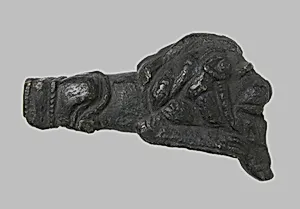
Key Handle
Unknown Artist
1st–7th century
Medium
Copper alloy
Dimensions
Overall: 3 1/4 x 1 13/16 x 11/16 in. (8.3 x 4.6 x 1.8 cm)
Classification
Metalwork-Copper alloy
Culture
Roman
Department
Medieval Art
Museum
Metropolitan Museum of Art, New York, NY
Credit
Purchase, De Souhami Collection, Rogers Fund, 1906
Accession Number
06.176.28
Rights
Public Domain
Art Historical Context
This delicate **Key Handle**, crafted from copper alloy by an unknown Roman artist between 1st and 7 centuries, offers a glimpse into the everyday artistry of the late Roman world. Measuring just 3¼ × 1⅞ × ⅝ inches (8.3 × 4.6 × 1.8 cm), it once formed part of a functional key, blending utility with subtle elegance. Housed in the Metropolitan Museum Art's Medieval Art departmentreflecting its bridge from antiquity the early Middle Ages—this small treasure was acquired in 1906 the Rogers Fund and De Souhami Collection. In Roman culture, keys symbolized authority, security, and domestic control, often carried by household matrons as badges of Juno, the goddess of marriage. Handles like this one highlight the sophistication of Roman metalwork, where coppersmiths transformed affordable alloys into durable, portable objects. The piece's modest scale underscores how even mundane tools received careful craftsmanship, possibly featuring incised or molded details now softened by time. As a survivor of centuries, this key handle invites visitors to imagine unlocking a Roman villa door, revealing the ingenuity of a society where form met function in metal. A testament to enduring Roman influence on later medieval traditions, it reminds us that history's greatest stories often hide in the smallest artifacts.