
Key Handle
Unknown Artist
1st–2nd century
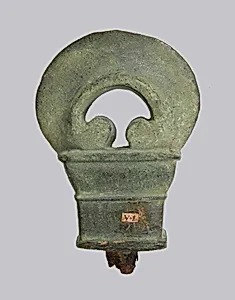
Medium
Copper alloy
Dimensions
Overall: 3 5/16 x 2 3/16 x 15/16 in. (8.4 x 5.6 x 2.4 cm)
Classification
Metalwork-Copper alloy
Culture
Roman
Department
Medieval Art
Museum
Metropolitan Museum of Art, New York, NY
Credit
Purchase, De Souhami Collection, Rogers Fund, 1906
Accession Number
06.176.4
Rights
Public Domain
Art Historical Context
Nestled in the Metropolitan Museum of Art's collection this delicate *Key Handle* from the1st–2nd Roman world exemplifies the everyday artistry of ancient metalworkers. Crafted from copper alloy—a durable material akin to bronze—this small object measures just 3 5/16 x 2 3/16 x 15/16 inches, fitting neatly in the palm of a hand. Acquired in 1906 through the De Souhami Collection and Fund, it offers a tangible glimpse into Roman domestic life. In the bustling Roman Empire, keys symbolized security and status, often adorning doors, chests, or shrines. Handles like this one were typically cast using the lost-wax technique, allowing for intricate modeling that elevated functional items to sculptural beauty. Though the artist's identity is lost to time, the piece reflects the empire's sophisticated metalworking traditions, blending utility with subtle elegance. This artifact bridges the practical and the profound, reminding us how Romans infused craftsmanship into the ordinary. Displayed in the Medieval Art department, it underscores the continuity of metalwork excellence from antiquity onward—a quiet testament to a civilization's ingenuity.