
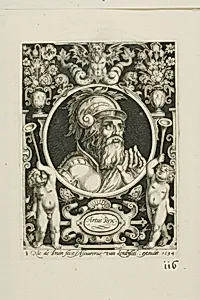
King Arthur, plate eight from The Nine Worthies
Medium
Engraving in black on cream laid paper
Dimensions
Image: 11.8 × 8.7 cm (4 11/16 × 3 7/16 in.); Plate: 12.4 × 9.1 cm (4 15/16 × 3 5/8 in.); Sheet: 17.5 × 14.3 cm (6 15/16 × 5 11/16 in.)
Classification
engraving
Department
Prints and Drawings
Museum
Art Institute of Chicago
Accession Number
185114
Rights
Public Domain
Art Historical Context
Step into the legendary world of chivalry with *King Arthur, plate eight from The Nine Worthies*, an exquisite engraving by Dutch artist Nicolaes de Bruyn from 1594. De Bruyn, a master engraver of the Northern Renaissance, crafted this intimate image (11.8 × 8.7 cm) as part of a series celebrating nine exemplary figures of valor—biblical, historical, and mythical heroes revered in medieval and Renaissance Europe. King Arthur, the iconic British monarch from Arthurian legend, embodies knightly virtue, sword in hand and crowned in majesty, symbolizing the enduring ideal of courageous leadership. Printed in black ink on cream laid paper—a period staple with its distinctive chain lines visible under light—this work highlights engraving's precision. De Bruyn's technique employs fine, cross-hatched lines to create depth, texture, and dramatic contrast, allowing detailed armor, flowing banners, and regal poise to emerge from the plate (12.4 × 9.1 cm). Such prints were revolutionary for their time, making elite imagery accessible and reproducible, fueling the spread of chivalric tales during the late 16th century's cultural revival. Housed in the Art Institute of Chicago's Prints and Drawings Department, this piece captures a bridge between myth and morality, reminding us how Renaissance artists like de Bruyn immortalized legends to inspire virtue in everyday viewers. A tiny treasure packed with heroic spirit!
About the Artist
Nicolaes de Bruyn · 1571–1656
Nicolaes de Bruyn was a Flemish printmaker born in Antwerp in 1571, active during the late sixteenth and early seventeenth centuries and known primarily for his large, elaborately detailed engravings of landscapes, hunting scenes, and biblical and mythological subjects. He trained in the tradition of Flemish reproductive engraving and was deeply influenced by the work of his contemporaries and pre...