
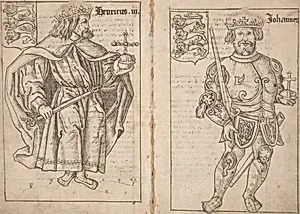
King John [right side]
16th century
Medium
pen and brown-black ink over black chalk on laid paper
Dimensions
overall (approximate): 32 x 22.5 cm (12 5/8 x 8 7/8 in.)
Classification
Drawing
Department
CG-E
Museum
National Gallery of Art, Washington, D.C.
Credit
Rosenwald Collection
Accession Number
1980.45.1569.a
Rights
Public Domain
Art Historical Context
This delicate 16th-century drawing titled *King John [right side*, captures a historical figure from England's medieval past through the skilled hand of an anonymous English artist Rendered in pen and brown-black ink over black chalk on laid paper it measures approximately 32 x 22.5 cm and forms part of the Rosenwald at the National Gallery of Art. Theright side]" designation hints at it being one half of a larger compositional study, perhaps for a portrait or illustrative series, showcasing the preparatory nature of Renaissance-era draftsmanship. King John (r. 1199–1216), infamous for sealing the Magna Carta in 1215 and starring in Robin Hood legends, held renewed fascination in Tudor England, where monarchs like Henry VIII drew parallels to their own reigns. This artwork reflects that 16th-century interest in medieval history, blending historical reverence with emerging portrait traditions. The black chalk underdrawing provided a subtle tonal foundation, allowing the precise ink lines to define contours and details with fluid confidence—a technique common in English workshops influenced by continental Renaissance practices. As a rare surviving drawing from this period, it offers insight into the era's artistic processes, where paper served as an affordable canvas for experimentation before final works in paint or print. Visitors will appreciate its intimate scale and the way it bridges medieval lore with early modern artistry.