
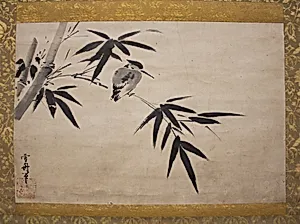
竹に翡翠図|Kingfisher and Bamboo
19th century
Medium
Hanging scroll; ink on paper
Dimensions
Image: 10 1/2 × 15 3/4 in. (26.7 × 40 cm) Overall with mounting: 45 × 20 5/8 in. (114.3 × 52.4 cm) Overall with knobs: 45 in. × 22 3/8 in. × 1 in (diam. of knobs) . (114.3 × 56.8 × 2.5 cm)
Classification
Paintings
Culture & Period
Japan · Edo (1615–1868)–Meiji (1868–1912) period
Department
Asian Art
Museum
Metropolitan Museum of Art, New York, NY
Credit
Charles Stewart Smith Collection, Gift of Mrs. Charles Stewart Smith, Charles Stewart Smith Jr., and Howard Caswell Smith, in memory of Charles Stewart Smith, 1914
Accession Number
14.76.8
Rights
Public Domain
Tags
Art Historical Context
Behold *Kingfisher and Bamboo* (竹に翡翠図), a delicate hanging scroll in ink on paper attributed to the legendary Japanese master Sesshū Tōyō (1420–1506), though created in the 19th century during Japan's Edo (1615–1868) to Meiji (1868–1912) transition. Measuring just 10½ × 15¾ inches, this intimate painting exemplifies the suiboku-ga (ink monochrome) tradition Sesshū pioneered, blending-inspired minimalism with bold, expressive brushwork. Sesshū, a Zen monk turned artist, drew from Chinese Song dynasty influences to capture nature's essence, and this work reflects his enduring legacy through later followers who revived his style amid Japan's cultural shifts. The composition poetically unites a vibrant kingfisher perched amid swaying bamboo stalks, symbols of resilience and fleeting beauty in Japanese aesthetics. Bamboo's segmented leaves and slender stalks are rendered with masterful ink washes—dry, wet, and splashed techniques creating texture and depth on the paper. Hanging scrolls like this were cherished in elite homes or temples, unrolled for contemplation during tea ceremonies or seasonal displays, evoking wabi-sabi impermanence. A gift to the Metropolitan Museum of Art in 1914 from the Charles Stewart Smith Collection, this piece bridges Muromachi-era innovation with 19th-century reverence, inviting viewers to savor the harmonious interplay of bird and plant in timeless Japanese artistry.