
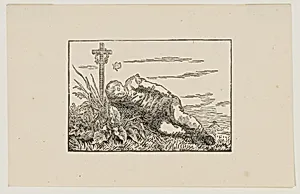
Knabe auf einem Grab schlafend (Boy sleeping on a grave)
probably 1803
Medium
Woodcut
Dimensions
Image: 3 1/16 × 4 1/2 in. (7.8 × 11.4 cm) Sheet: 5 1/16 × 7 13/16 in. (12.8 × 19.9 cm)
Classification
Prints
Department
Drawings and Prints
Museum
Metropolitan Museum of Art, New York, NY
Credit
Harris Brisbane Dick Fund, 1927
Accession Number
27.35
Rights
Public Domain
Art Historical Context
This delicate woodcut, titled *Knabe auf einem Grab schlafend* (Boy Sleeping on a Grave), dates to around 1803 and is to the German Romantic artist Caspar David Friedrich, with the print likely executed by Christian Friedrich. Created during the early years of the 19th century, it reflects the Romantic movement’s deep fascination with mortality, nature, and the inner life of the individual. Friedrich’s work often explored themes of transience and spiritual reflection, and this small print captures those ideas through its quiet, contemplative scene. The woodcut medium, with its bold yet intimate lines, was well-suited for conveying emotional depth in a compact format. Measuring just over three by four inches in the image area, the piece may have been intended for private viewing or inclusion in illustrated books, allowing viewers a personal encounter with its somber subject. The boy’s vulnerable pose atop the grave evokes both innocence and the ever-present shadow of death, inviting quiet meditation on life’s fragility. Housed in the Metropolitan Museum of Art’s collection of prints and drawings, this work highlights Friedrich’s influence on early Romantic printmaking and its power to stir profound emotional responses even in miniature scale.