
Knee Buckle
Unknown Artist
1730–75
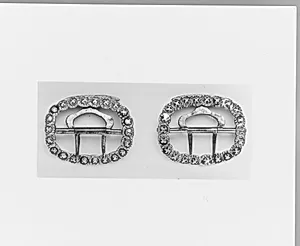
Medium
Silver
Dimensions
1 7/16 x 1 1/8 in. (3.7 x 2.9 cm)
Classification
Buckle
Culture
American
Department
The American Wing
Museum
Metropolitan Museum of Art, New York, NY
Credit
Bequest of Alphonso T. Clearwater, 1933
Accession Number
33.120.153
Rights
Public Domain
Art Historical Context
Nestled in the American Wing of the Metropolitan Museum Art, this delicate *Knee Buckle* (1730–75) exemplifies the refined silver craftsmanship of colonial America. Fashioned from gleaming silver and measuring just 1 7/16 x 1 1/8 inches, this petite accessory was designed to secure the kneebands of breeches—a staple of men's formal attire during the 18th century. Its small scale belies its role as a subtle yet luxurious adornment, likely produced by an unknown silversmith in one of the bustling urban centers like New York, Philadelphia, or Boston. In an era when silver objects signified wealth and social standing, knee buckles like this one were prized possessions among the colonial elite. Imported from England or crafted locally by skilled artisans, they reflected the growing sophistication of American decorative arts amid increasing trade and prosperity before the Revolution. The medium's durability and luster made silver ideal for such functional jewelry, often featuring simple chased or engraved designs to catch the light during assemblies or courtly events. Bequeathed to the Met in 1933 by Alphonso T. Clearwater, this buckle offers a tangible glimpse into everyday elegance of early American life, bridging fashion, craftsmanship, and cultural aspiration. Visitors can appreciate how such unassuming items wove status into the fabric of colonial society.