
Knife
ca. 1730–50
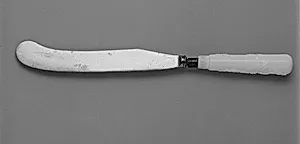
Medium
Soft-paste porcelain
Dimensions
Total L. 1 1/2 in. (3.8 cm.)
Classification
Ceramics-Porcelain
Culture
French, possibly Saint-Cloud
Department
European Sculpture and Decorative Arts
Museum
Metropolitan Museum of Art, New York, NY
Credit
The Hans Syz Collection, Gift of Stephan B. Syz and John D. Syz, 1995
Accession Number
1995.268.229
Rights
Public Domain
Art Historical Context
This exquisite miniature *Knife* from the Saint-Cloud factory dating to around 1730–50, exemplifies the ingenuity of early French porcelain production. Crafted from soft-paste porcelain—a delicate, tin-glazed material that European makers developed as a precursor to true hard-paste porcelain—this tiny object measures just 1 1/2 inches long. Likely the handle of a small eating or decorative utensil, it reflects the luxury of 18th-century decorative arts where porcelain was prized for its translucency and fine modeling. The Saint-Cloud factory, near Paris, was a pioneer in soft-paste techniques during the Rococo era, producing whimsical, everyday objects elevated to art. These wares mimicked costly Chinese imports while showcasing French flair, often with molded details and vibrant glazes. This piece, part of The Hans Syz Collection at The Metropolitan Museum of Art, highlights the factory's role in democratizing porcelain for elite tables and personal accessories. Its diminutive scale invites wonder: imagine it adorning a lady's chatelaine or a dollhouse banquet. As a survivor of fragile porcelain, it underscores the technical mastery and cultural prestige of French ceramics in the age of Versailles.
About the Artist
Saint-Cloud factory · 1693–1766
The Saint-Cloud porcelain factory, situated on the Seine in the town of Saint-Cloud near Paris, revolutionized European ceramics as the first to manufacture soft-paste porcelain commercially, beginning in 1693. Originally established around 1664-1666 as a faience workshop, it shifted to porcelain under Pierre Chicaneau, a potter whose experiments yielded a frit-based paste with a warm yellowish or...