
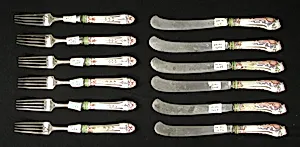
Knife
Medium
Hard-paste porcelain, steel
Dimensions
Knives L. 8 in. (20.3 cm.), Forks L. 7-1/8 in. (18.1 cm.)
Classification
Ceramics-Porcelain
Culture
Austrian, Vienna
Department
European Sculpture and Decorative Arts
Museum
Metropolitan Museum of Art, New York, NY
Credit
Gift of Irwin Untermyer, 1964
Accession Number
64.101.1649
Rights
Public Domain
Art Historical Context
Step into the opulent world of 18th-century Viennese dining with this exquisite set of knives and forks from the Innocentius Du Paquier, circa 1730. Crafted at the Vienna Porcelain Manactory—Europe's second producer of true hard-paste porcelain after Meissen—these pieces feature delicate porcelain handles paired with sturdy steel blades. Measuring 8 inches for the knives and about 7 inches for the, they exemplify the fusion of functionality and fine art in European decorative arts. Hard-paste porcelain, fired at high temperatures for exceptional durability and translucency, marked a technical triumph for the Du Paquier factory (active 1718–1744). Sponsored by the Habsburg court, it rivaled Chinese imports and fueled the Baroque-to-Rococo shift in luxury goods. These utensils weren't just for eating; they were status symbols, showcasing the manufactory's prowess in molding and glazing porcelain to mimic ivory or silver, perfect for lavish banquets. Today, housed in The Metropolitan Museum of Art's European Sculpture and Decorative Arts Department (gift of Irwin Untermyer, 1964), this set highlights Austria's cultural golden age. Imagine them gracing a noble table, whispering tales of innovation and imperial elegance.
About the Artist
Claudius Innocentius Du Paquier period|Vienna ( |Austrian) · |1718 – |1744
|1718–1744