
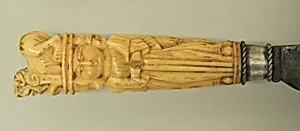
Knife
Unknown Artist
17th century
Medium
Steel, ivory, silver
Dimensions
L. 10 1/8 in. (25.7 cm); L. of blade 5 13/16 in. (14.8 cm); W. 1 1/16 in. (2.7 cm); W. of blade 3/4 in. (1.9 cm); thickness of blade 1/8 in. (0.3 cm); Wt. 3 oz. (85 g)
Classification
Knives
Culture
Italian
Department
Arms and Armor
Museum
Metropolitan Museum of Art, New York, NY
Credit
Bequest of Alan Rutherfurd Stuyvesant, 1954
Accession Number
54.46.39
Rights
Public Domain
Tags
Art Historical Context
This exquisite 17th-century Italian knife, crafted from steel, ivory, and silver, exemplifies the blend of functionality and artistry in Renaissance-era arms and armor. Measuring just over 10 inches in length with a slender 5 13/16-inch blade, it weighs a mere 3 ounces, making it a delicate yet potent object—likely a personal dagger or paring knife carried by nobility. Housed in the Metropolitan Museum of Art's Arms and Armor Department through the bequest of Alan Rutherfurd Stuyvesant in 1954, its precise dimensions highlight the meticulous engineering of the period, where weapons doubled as status symbols. The knife's materials reveal sophisticated techniques: a forged steel blade for sharpness and durability, paired with luxurious ivory and silver for the hilt, often adorned with human figures in carved or inlaid motifs. These decorative elements, common in Italian workshops, transformed utilitarian tools into wearable art, reflecting Baroque influences with their attention to anatomical detail and narrative scenes. Such knives were prized in courts, symbolizing both defense and refinement amid Italy's turbulent 17th-century politics. As an anonymous masterpiece, this piece invites us to ponder the unnamed artisans who elevated everyday steel into sculptural elegance, bridging the worlds of combat and connoisseurship.