
Knife
Unknown Artist
580–640
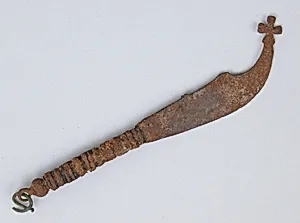
Medium
Iron
Dimensions
Overall: 5 3/4 x 1 3/16 x 3/8 in. (14.6 x 3 x 0.9 cm)
Classification
Metalwork-Iron
Culture
Coptic
Department
Medieval Art
Museum
Metropolitan Museum of Art, New York, NY
Credit
Rogers Fund, 1914
Accession Number
14.1.431
Rights
Public Domain
Tags
Art Historical Context
This modest iron knife, crafted between 580 and 640 CE, offers a glimpse into the daily life of Coptic Egypt during the late antique period. Measuring just under six inches, the object was likely a practical tool for cutting or carving, yet its survival in the Metropolitan Museum’s collection highlights the enduring value of even utilitarian metalwork from this era. Coptic culture, rooted in Egypt’s early Christian communities, blended local traditions with influences from the Byzantine world, and such simple implements reflect the resourcefulness of artisans working with readily available iron. Iron metalwork held particular importance in medieval societies, where skilled smiths forged durable tools essential for agriculture, craft, and household use. Though the artist remains unknown, the knife’s straightforward form demonstrates the functional elegance typical of Coptic metalwork—objects valued more for reliability than ornament. Acquired by the museum in 1914, this piece invites visitors to consider how ordinary artifacts illuminate the broader story of faith, trade, and craftsmanship in early medieval Egypt.