
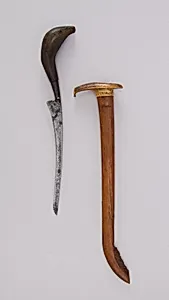
Knife (Bade-bade) with Sheath
Unknown Artist
16th–19th century
Medium
Steel, wood, bone
Dimensions
H. with sheath 17 in. (43.2 cm); H. without sheath 11 5/8 in. (29.5 cm); H. of blade 7 1/4 in. (18.4 cm); W. 2 3/16 in. (5.6 cm); Wt. 4.3 oz. (121.9 g); Wt. of sheath 1.8 oz. (51 g)
Classification
Daggers
Culture
Sumatran, possibly Acheen
Department
Arms and Armor
Museum
Metropolitan Museum of Art, New York, NY
Credit
Bequest of George C. Stone, 1935
Accession Number
36.25.704a, b
Rights
Public Domain
Art Historical Context
This exquisite *Knife (Bade-bade) with Sheath* hails from Sumatra, possibly the Aceh region of Indonesia, dating to the 16th–19th century. Crafted from steel for the blade, with a hilt and sheath of wood and bone, it 17 inches (43.2 cm) with its sheath and weighs just 4.3 ounces (121.9 g) without. The straight, double-edged blade—7¼ inches (18.4 cm) long—exemplifies fine metalworking, likely pattern-welded or forged for strength and sharpness, essential for a dagger used in close combat or as a status symbol. In Sumatran culture, particularly among the warrior elite of Aceh's sultanates, the *bade-bade* was more than a weapon; it embodied martial prowess and social prestige. Worn at the waist, these daggers reflected the region's rich tradition of arms craftsmanship, blending functionality with subtle ornamentation in organic materials like bone for grips that ensured a secure hold. The lightweight sheath, at 1.8 ounces (51 g), allowed for discreet carry, underscoring their role in daily life and ceremony. Now part of the Metropolitan Museum of Art's Arms and Armor collection, thanks to the 1935 bequest of George C. Stone, this piece offers a tangible link to Southeast Asia's dynamic history of trade, conflict, and artistry.