
Knife Box
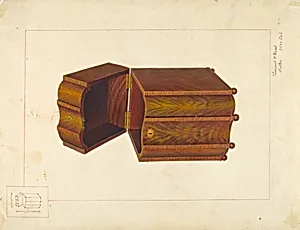
Medium
watercolor, pen and ink, graphite on paper
Dimensions
overall: 30.6 x 23.2 cm (12 1/16 x 9 1/8 in.) Original IAD Object: 15" high; 12" long; 10 1/4" wide
Classification
Index of American Design
Department
CG-W
Museum
National Gallery of Art, Washington, D.C.
Credit
Index of American Design
Accession Number
1943.8.8864
Rights
Public Domain
Art Historical Context
**Knife Box** * P. Rosel and Saltar, c. 1938* Watercolor, pen and ink, graphite on paper, 30.6 × 23.2 cm (12 1/16 × 9 1/8 in.) *Index of American Design, National Gallery of Art* exquisite rendering captures a classic American knife box, a practical yet elegant storage case for table cutlery, typically found in 18th- and 19th-century households. Measuring about 15 inches high, 12 inches long, 10¼ inches wide in its original form, the box exemplifies early American craftsmanship, often featuring fine woods and decorative hardware. Artists Vincent P. Rosel and Gordon Saltar meticulously documented its form using watercolor for subtle color tones, pen and ink for precise lines, and graphite for shading, creating a vivid, lifelike study on paper. Created around 1938 as part of the Index of American Design—a New Deal-era Federal Art Project under the Works Progress Administration—this artwork reflects a national effort to celebrate and preserve the nation's folk art and decorative traditions during the Great Depression. By rendering thousands of everyday objects with artistic accuracy, projects like this highlighted the ingenuity of American makers, bridging historical artifacts with modern audiences. Today, it invites us to appreciate the humble beauty of utilitarian design in our cultural heritage.